Start Here Situation Navigator Guides Caregiver First Aid The Method The Course Field Notes For Professionals About
dementia steady for professionals
Coming: in clinical review

Groundwork

The six-hour dementia care course your caregivers take on their own phones, in their first sixty days. Eight modules, one real task on a shift after each, and a check nobody passes by skimming. It covers the seven topics Illinois names for initial dementia training, and it ends with a record a surveyor can read and a door to Dementia Steady Proficiency.

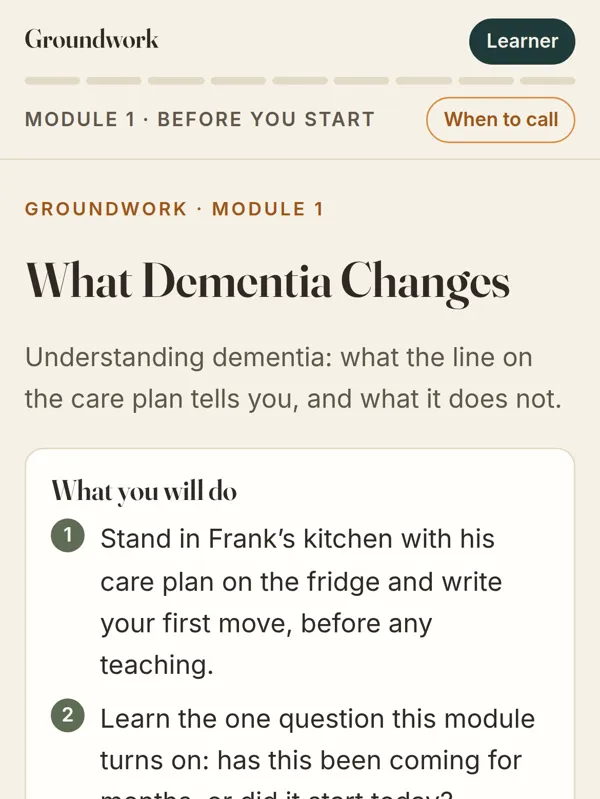
Groundwork on a phone: Module 1, What Dementia Changes, with the list of what the caregiver will do, starting in Frank's kitchen with his care plan on the fridge

What it is

Groundwork is the caregiver route in the Dementia Steady program: the reading and the first practice of the Steadier Ground Method, done alone, on a phone, in the gaps of a working week. Notice, Read and Reach, on the foundation of who the person still is, with Steady as the ground beneath all of it. Three fictional clients, Frank, Eleanor and Miriam, run the whole way through, so by Module 8 a caregiver knows them the way they will come to know a real client.

It is not a slide deck with a quiz at the end. Every module is built around moments a caregiver already recognizes: the door that does not open, the shower that is refused, the client who was fine on Monday and is not on Wednesday. The lesson is what to do in the next minute, and when the next minute belongs to a nurse or a doctor instead.

Six hours
Eight modules of 35 to 50 minutes, opened in order, plus the shift tasks. Illinois asks for six hours in the first 60 days, and the certificate states the hours.
On their own phone
No login to remember, no laptop, no classroom. A link, and a module that saves where they stopped.
One real task per module
Something done on an actual shift and written up in two lines. The supervisor reads every one, and approves every one before the certificate is issued.
A check that reads the reading
Twelve decisions per module, built so that general good sense fails them and the module's rule passes them, and tested that way before release. It can be taken again.

How a module works

Every module runs the same way, so the second one is already familiar.

  1. Minute oneBefore any teaching, one scene and one decision. The caregiver writes what they would do today, and their answer comes back to them at the end of the module.
  2. Learn and practiceShort cards, each with the moment it is for and the moment it goes wrong, and real scenes that play out from what the caregiver chooses. Read is always taught body first: what to rule out before anything is read as behavior.
  3. ReflectionA few lines about a moment from their own work. Not graded. Read by the supervisor.
  4. The field taskOne thing tried on a real shift, written up in two lines. The supervisor reads it, and a note that describes a change in a client is flagged for a report the same day, whether or not it was written in a course.
  5. The checkTwelve decisions across six pairs of scenes, where the details decide the answer. It cannot be passed by guessing, the caregiver sees why for every answer, and it can be taken again.

The eight modules

In the order they open. Nothing here teaches a caregiver to name what a client has; the diagnosis is a record field a doctor writes, and the course says so in Module 1.

1. What Dementia Changes

What the line on the care plan tells a caregiver and what it does not: what dementia changes and in what order, four common kinds by what each changes first, and one rule that decides who to call. Months is the disease. Today is the body.

2. How to Reach Them

Six examples of Reach for someone whose words are becoming unreliable, and the Care Profile that tells staff who they are reaching.

3. Behavior is Communication

Read, opening on the body. Refusal, repetition, agitation and accusation read for the need underneath, and what a caregiver does with what they find.

4. The Hardest Room in the House

Personal care under pressure. Three reasonable attempts, then stop; what the room can produce; what goes to the nurse the same shift.

5. Notice and Steady

The late afternoon, persistent refusal, paranoia, exit-seeking and the family in the room. Notice turned inward, and Steady as the ground under all five.

6. Staying Sharp

Notice turned outward, and the five-element observation note a supervisor can act on and a doctor takes seriously.

7. The Home and the Day

Safe environments and meaningful activity as one idea: what the room is asking of the person, which hazards come back once they are alone, and a day with their job in it.

8. Steady in Practice

One full run, end to end: the first approach that does not land, the second attempt, the decision about what to stop and who to call, the handoff, and the note. Then the brief for Proficiency.
What the record says

Illinois's Alzheimer's Disease and Related Dementias Services Act asks a licensed home services or home nursing agency for six hours of dementia training in an employee's first 60 days and three hours a year after, covering seven named topics. Illinois approves no training vendor. What a surveyor reads is the subject matter and the hours, so that is what the Certificate of Completion states.

Topic named in the ActWhere Groundwork covers it
Understanding dementiaModule 1, What Dementia Changes
Communicating effectivelyModule 2, How to Reach Them
Assisting with activities of daily livingModule 4, The Hardest Room in the House, alongside your agency's own technique training
Problem solving with challenging behaviorModules 3 and 5, Behavior is Communication and Notice and Steady
Fundamentals of dementia careModules 2, 6 and 8: the Care Profile, the observation note, and the full run
Safe environmentsModule 7, The Home and the Day
Managing activitiesModule 7, The Home and the Day

The certificate lists the seven topics with the hours against each and the general home services training subjects the course touches, so an agency can file it without writing a crosswalk. It says the training covers the topics named in the Act. It never says approved, because nothing is. The three annual hours come from the practice library below, and the supervisor who has completed the Lead Track meets the Act's supervisor requirement by curriculum rather than by five years of experience. Agencies outside Illinois get the same record; check it against your own state's rule.

What comes after

Groundwork is the reading. Two things turn it into something an agency can stand behind.

Proficiency
Within days of Module 8, one unseen scenario, scored against a fixed rubric with three gates by two supervisors. A pass earns Dementia Steady Proficiency, numbered in the register and good for two years. How it is scored.
The practice library
The same eight modules, run live by your own Dementia Steady Lead: six 70-minute sessions in pairs, each with a second attempt, on your in-service calendar. Three sessions a year cover the annual advanced hours.
The loop
What a caregiver writes in a field task or an observation note goes to the supervisor, into the client's reassessment, and into the next shift's guide. Groundwork teaches the note. The Lead Track teaches the loop.
The Lead Track
For the supervisor who signs the field tasks, runs the practice sessions and scores Proficiency, and for community instructors. Opens after the first Groundwork beta. About the Lead Track.

How it is licensed

Everything a caregiver needs to know about the method is free on this site, including the family course, and Groundwork does not change that. What an agency licenses is the course as a system: the modules with their checks, the field tasks and the supervisor's sign-off, the measured hours, the Certificate of Completion, and the door to Proficiency. It is licensed per agency, by headcount, for a year at a time, with no per-seat fee, so a new hire in month eleven costs nothing extra. Pricing is published when it opens. Ten free Steady Check sittings and the free workshop are available now, and are the right place to start before then.

Tell me when it opens

Groundwork is in independent clinical review and is not yet available. Leave your details and you will hear once, when it opens, with the pricing. Nothing else.

One email when Groundwork opens, and the occasional professional note from Dementia Steady. Unsubscribe with one click, any time.