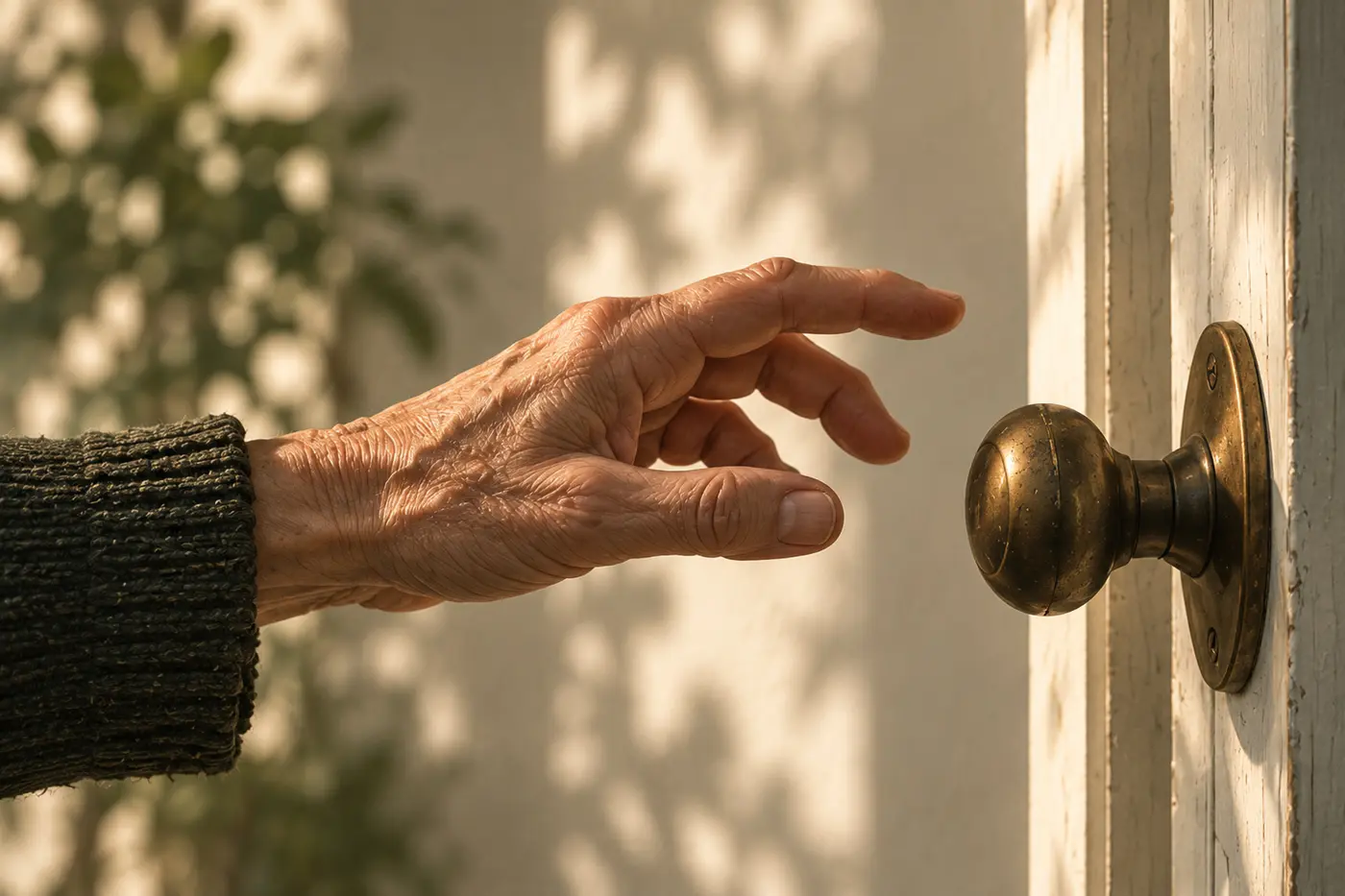
Your father accuses you of stealing his wallet, for the third time this week. Before you've even decided how to respond, your jaw has tightened and your voice has gone flat. That half-second, before the words come out, is where Notice actually lives.
What's actually happening
Most caregivers think of noticing as something you do to the person you're caring for: watching for a new limp, a skipped meal, a shift in mood. That's real, and it matters. But there's a faster, quieter version of the same skill that runs in the moment itself, aimed at you, not them. Before you can change your approach or figure out what a behavior means, you have to catch your own reaction rising, the tightened jaw, the sharpened voice, the urge to correct or defend, before it takes over the moment.
The alternative: catch it before it decides for you
The reaction is going to show up whether you notice it or not. What changes is whether you catch it while there's still room to choose, or only afterward, once it's already shaped what you said or how you said it. Catching it sounds like a flicker of self-awareness: "I'm about to snap." "I'm rushing her." "My voice just went sharp." That flicker is the whole skill. It doesn't require calm, and it doesn't require getting rid of the reaction. It just requires seeing it a half-second sooner than you used to.
A few things that help
Name it in your head, even in three words. "I'm getting defensive." "I'm about to rush her." Naming it is what separates noticing from just reacting.
Expect it to show up in your body first. A tightened jaw, a raised voice, a held breath usually arrives before the thought does. Your body is often the fastest messenger you have.
Catching it isn't the same as holding it. Once you've caught the reaction, staying steady through it is something else: the ground the other three skills stand on, not a fourth skill of its own. Notice's job is just the catch, not the follow-through.
It gets faster with practice, not willpower. The first hundred times, you'll catch it late, after you've already snapped. That's not failure. The gap between the reaction and the catch is what shrinks with repetition.
This is Notice's in-the-moment range, the first of two, and the one most caregivers have never been taught to name: catching your own reaction before it decides what happens next, the opening beat of the loop taught on the Steadier Ground Method page. Over time, the same skill extends outward, into tracking patterns in the person you're caring for. Both ranges are the same habit: seeing clearly before you act.
When you feel yourself about to react
Read more on catching your own reaction and tracking patterns over time in the diagnosis guide, Diagnosed With Dementia: Now What?, which includes the Care Planning Essentials worksheet.
This is one piece of the full guide, "Diagnosed With Dementia: Now What?"